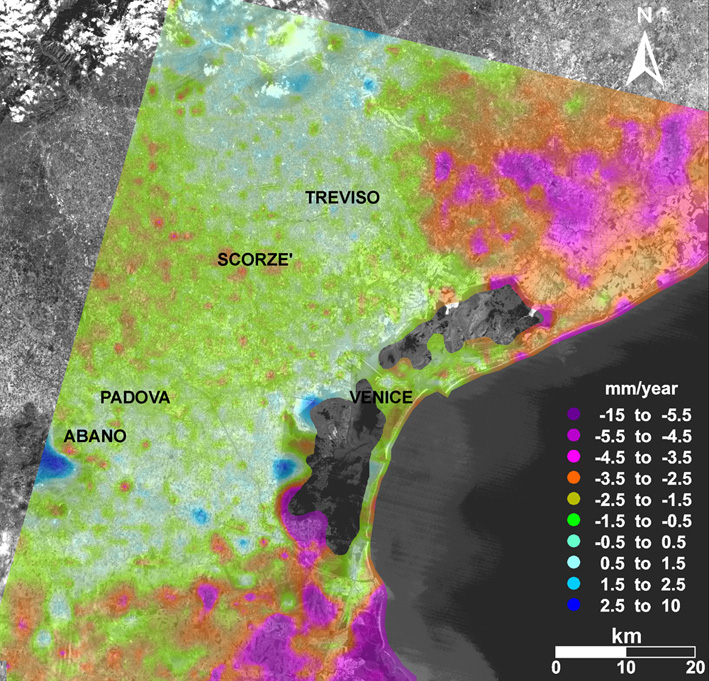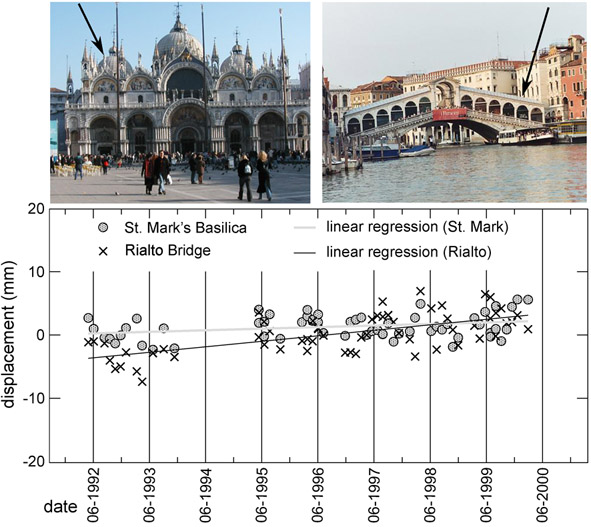
|
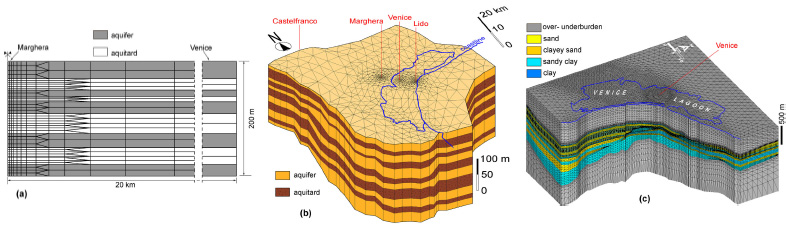
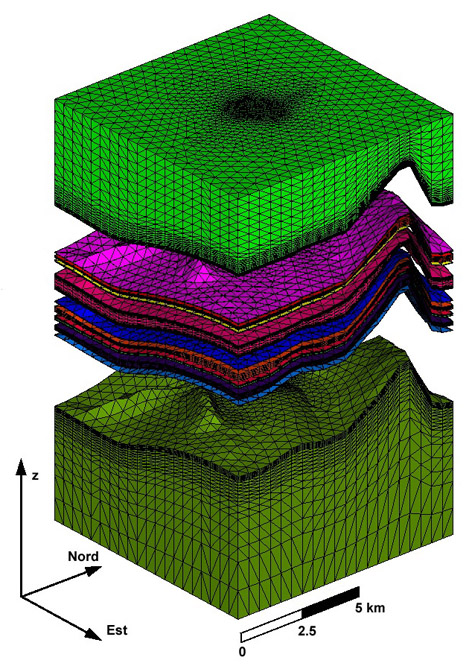
Using an accurate 3-D reconstruction of the Quaternary
deposits, developed very recently from about 1050 km of multichannel seismic
profiles and eight exploration wells,
Teatini et al., 2011
(pdf)
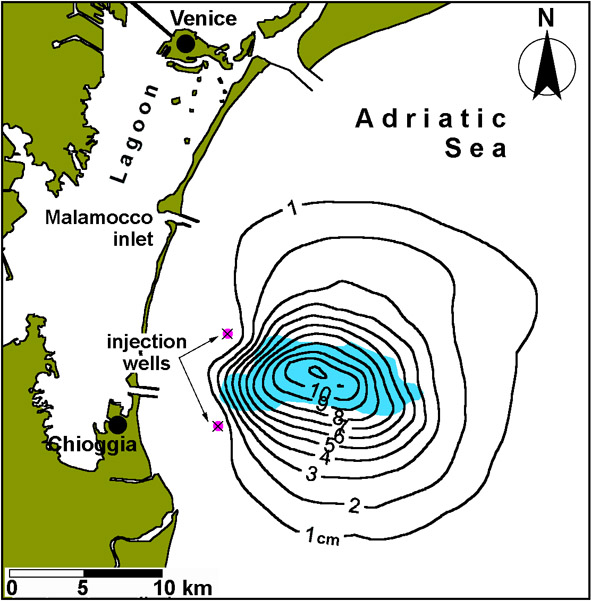
provide a reliable predictions of the expected uplift of Venice because
of seawater injection into deep aquifers through 12 wells located
on a 10 km diameter circle (marked in red in the figure).
Despite the complex geometry of the injected formations,
as is shown by the axonometric view of the three-dimensional FE
model sectioned along the coastline of the northern Adriatic Sea
(vertical exaggeration is 10x), a proper adjustment of the injection pressure
in each well, according to its position with respect to the main features
(extent and thickness) of the injected geologic sequences, allows for a prediction
of a quite uniform 26 cm uplift 10 years after pumping inception.
| 
|
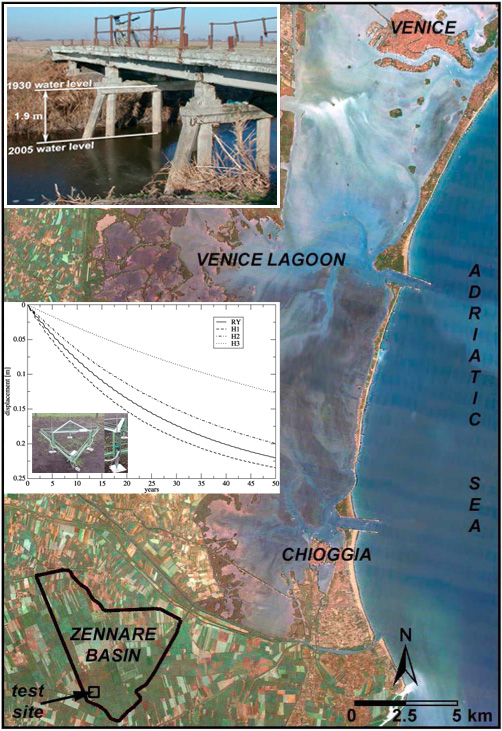
Land subsidence in drained cultivated
peatlands is responsible for a number of serious environmental concerns and
economical problems at both the local and the global scale.
In low-lying coastal areas it enhances the risk of flooding, the saltwater
contamination of shallow aquifers, and the maintenance costs of the systems
that help keep the farmland drained.
Since the subsidence is a major consequence of the bio-oxidation of the soil
organic fraction in the upper aerated zone, cropped peatlands in temperate
and tropic regions are important sources of CO2 into the atmosphere.
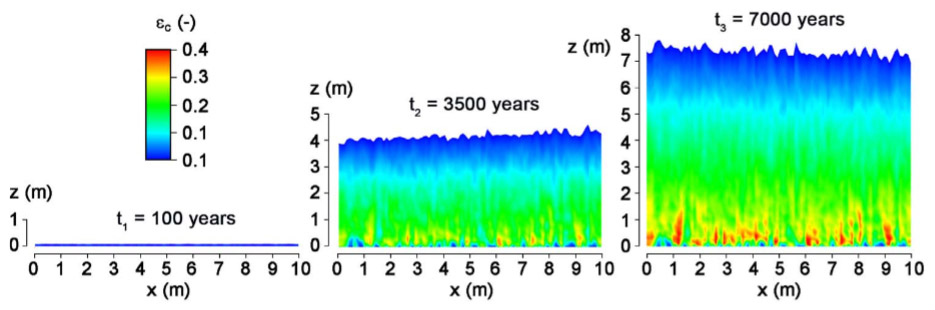
A 4-year long experimental study has been performed in a drained peatland located
south of the Venice Lagoon, Italy, to help calibrate a land subsidence model
developed to predict the expected behavior of the ground surface elevation.
After:
Zanello et al., 2011
(pdf)
|